United Kingdom · PDF to Excel, CSV, QBO, OFX, Xero
Convert Barclays statements to Excel, CSV or QBO
BetaBeta: built from the bank's published layout
Barclays prints a running balance on every row, so each converted line can be checked against the one above it. Download Excel, CSV, QBO, OFX, Xero CSV or QuickBooks Online CSV; the PDF never leaves your device. Beta: tested on synthetic replicas of the Barclays layout, not yet on real statements. Wrong row? Click "This row is wrong".
Barclays statement at a glance
- Country
- United Kingdom
- Statement columns
- Date · Description · Debit · Credit · Balance
- Date format
- D MMM, D MMM YYYY, D MMM YY
- Number format
- 1,234.56
- Currency
- GBP
- Balance check
- Running balance on every row, then the closing balance
- Export formats
- Excel (XLSX) · CSV · QBO (Web Connect) · OFX · Xero CSV · QuickBooks Online CSV
- CSV from the bank
- Not offered
Barclays statement layout
What the statement shows
- Public descriptions say statements list transactions in columns Date, Description, Money out, Money in and Balance.
- As described, Money out and Money in are separate columns, so the sign comes from the column and amounts are printed without a minus sign.
- Dates are described as printed as day and short month (for example 3 Dec) without a year; the year comes from the statement period.
- A running Balance column is described, and a balance brought forward line starts each page after the first.
- Statements are saved as PDF from Online Banking or the app; the help page describes printing and PDF only, with no CSV option.
How the converter reads it
Barclays prints its transactions in one table with five columns: Date, Description, Money out, Money in and Balance. That is about as friendly as a bank statement gets for conversion, because each piece of information has its own place on the page.
More detail
Money out and Money in are separate columns, and the figures inside them carry no minus sign. A converter therefore has to look at which column a number sits in to decide whether it is a debit or a credit. The converter maps the Money out column to negative amounts and the Money in column to positive ones, which is the convention most spreadsheets and accounting tools use.
The Balance column is the most useful part for checking. Barclays shows a running balance, so each row can be compared with the one before it: the previous balance, plus money in, minus money out, should give the new balance. When that check fails on a row, it usually points to a description that wrapped onto a second line or an amount that was read in the wrong column, and the converter flags that row.
Dates are short. A row shows a day and a short month, such as 3 Dec, with no year. The year is taken from the statement period. This matters in the January statement, when the first rows may still belong to December of the previous year. The export writes full dates so your accounting software does not have to work it out.
Each page after the first starts with a balance brought forward line. That line repeats the balance from the bottom of the previous page. It is not a transaction, and it is not exported as one. The converter uses the first one as the opening balance and checks the later ones against the running total, which is a simple way to catch a page that was skipped or read badly.
To get the PDF, Barclays Online Banking lets you open Manage accounts, then Statements and documents, and save a statement with the PDF icon. In the app, statements are under Help on the home page, and business customers see Statements directly on the home page. The Barclays help page on statements only talks about printing and PDF. It does not mention a CSV download, which is one reason people come looking for a converter in the first place.
Barclays is marked Beta on this site. The layout above was checked against the bank's official help pages, not against real statements, and Barclays will stay Beta until real files confirm it. Scanned paper statements and phone photos of statements are not supported, because they hold an image of the page and no text to read.
After the balance check passes, you can download Excel or CSV, or produce a QBO, OFX or Xero CSV file for import into your books.
Sources: the bank's help pages and public descriptions of sample statements.
How to download your statement from Barclays
On the website
- Open Online Banking and select Manage accounts, then Statements and documents.
- Choose the statement and save it with the PDF icon in the toolbar, or print it from the browser File menu.
In the mobile app
- In the Barclays app go to Help on the home page, then select Statements.
- Business account holders can select Statements directly from the home page.
Steps checked: November 1, 2026. No native CSV export is documented. The official statements help page describes printing and saving as PDF only; it does not mention a CSV export.
Sample preview and test results
Synthetic sample, not a real statement. Open the synthetic sample PDF
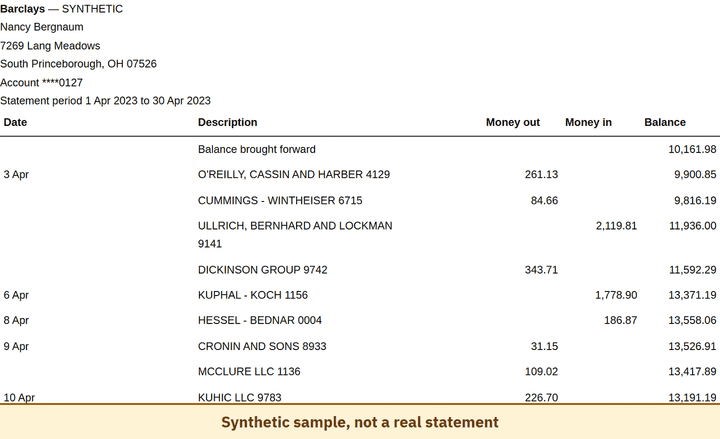
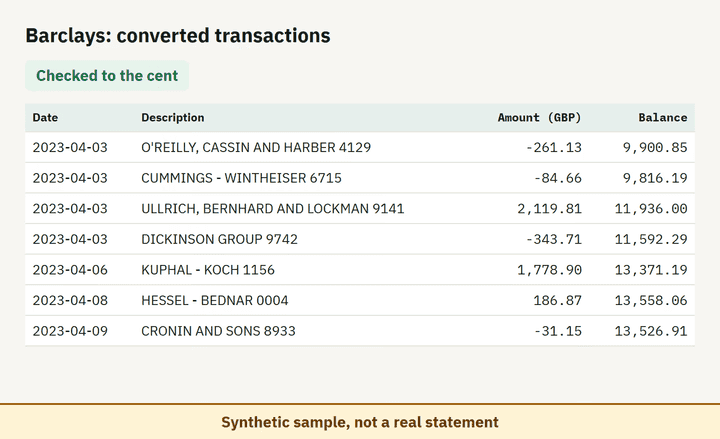
- Balance check passed on 100% of 8 perturbed synthetic files.
Which file to download from a Barclays statement
| Format | Imports into | Status |
|---|---|---|
| Excel (XLSX) | Microsoft Excel, Google Sheets, LibreOffice Calc, Apple Numbers | Available |
| CSV | Excel, Google Sheets, databases and scripts, most accounting tools that accept a custom CSV | Available |
| QBO (Web Connect) | QuickBooks Online (bank upload) | Available, follows the Intuit Web Connect specification |
| OFX | Xero, GnuCash, Moneydance, Banktivity, MoneyMoney, QuickBooks Online (bank upload) | Available, follows the OFX 2.2 specification |
| Xero CSV | Xero (Import a statement) | Available, follows the Xero CSV template |
| QuickBooks Online CSV | QuickBooks Online (Upload transactions) | Available, follows the QuickBooks Online 3-column layout |
Known limitations
- Beta: tested on synthetic replicas built from public Barclays layout information, not yet on real statements. If the result looks wrong, mark the row with 'This row is wrong' or use 'Send page layout', which sends the masked layout only and none of your figures.
- Scanned or photographed statements are not supported.
Barclays statement FAQ
Can I convert a Barclays PDF statement to Excel?
Yes. Drop the PDF into the converter on this page; it reads the Money out, Money in and Balance columns and checks the result against the statement balances.
How do I download a Barclays statement as PDF?
In Online Banking select Manage accounts, then Statements and documents, and use the PDF icon in the toolbar. In the app use Help, then Statements.
Does Barclays offer CSV statements?
The statements help page only describes PDF and printing. Check Online Banking for any transaction export before relying on it.
What does Balance brought forward mean on a Barclays statement?
It is the running balance carried over from the previous page or period. The converter uses it as the opening balance and cross-checks it on later pages.
Can I import the result into QuickBooks or Xero?
Yes. Export to QBO, OFX or the Xero CSV layout after the balance check passes.
Can I just use ChatGPT to convert my Barclays statement?
For a short statement, if you check the totals yourself. Here every Barclays row is checked against the statement balances for you. Converter or ChatGPT? See our comparison.
Test status
Last tested: November 2, 2026